
The “U”: Are the Miami Hurricanes Really Back?
For decades, Miami football has been more than wins and losses. It has been an identity. An attitude. A standard that demanded attention from the rest of college football. When people talk about “The U,” they are not just referencing a logo or a program, they are talking about a brand that was forged through dominance, swagger, and an unapologetic belief that Miami football was different.
That reputation was built in the 1980s, when Miami emerged as one of the most powerful forces the sport had ever seen. Those teams didn’t just win national championships; they changed how college football looked and felt. Speed, confidence, physicality, and edge defined Miami’s rise. The Hurricanes were feared, respected, and sometimes hated, and they embraced all of it. The brand of “The U” became synonymous with excellence and intimidation, setting a tone that would echo for decades.
As the century turned, Miami faced the challenge that all dominant programs eventually encounter, sustaining greatness. By the late 1990s, the Hurricanes were no longer sitting comfortably atop the sport. But instead of fading into nostalgia, Miami responded with one of the most dramatic resurgences college football has ever seen.
That resurgence peaked in 2001. The Hurricanes stormed through the season, overwhelming opponents with depth, speed, and talent at every position. The national championship that followed was not just a title, it was a reassertion of identity. Miami wasn’t simply back; it was again the measuring stick. That team reestablished the brand of “The U” for a new era, reminding the sport that Miami football, when aligned properly, could still dominate on the biggest stage.
However, sustaining that level of success proved difficult. After the early 2000s, the foundation began to crack. By 2007, following the departure of Larry Coker, Miami entered unfamiliar territory. That season marked the program’s first losing record since 1998, and it symbolized the beginning of a long stretch of inconsistency. Coaching changes, recruiting challenges, and shifting identities made it difficult for Miami to regain its footing.
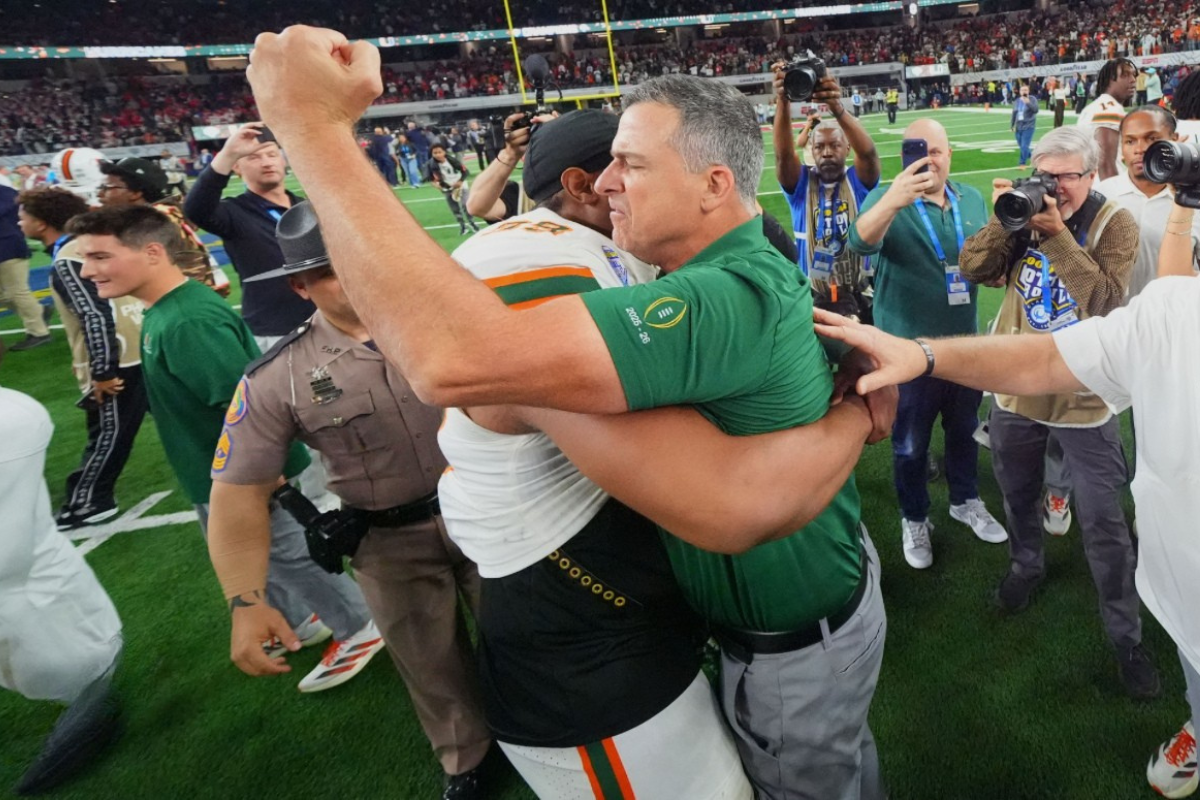
Photo by AP Julio Cortez
Mario Cristobal embracing with Miami Hurricane football player, Ahmad Moten, Sr. after winning the college football playoff quarterfinals against Ohio State on December 31, 2025
From 2007 onward, the Hurricanes lived in a frustrating cycle. There were flashes of promise, seasons that hinted at a return to prominence, but they were often followed by regression. Bowl appearances came and went, but meaningful postseason success was rare. Over nearly a decade, Miami managed just one bowl victory, coming in 2016 under Mark Richt. While Richt helped stabilize the program and restore respectability, the Hurricanes still felt far removed from the dominance that once defined them.
For a fan base raised on championships and swagger, respectability wasn’t enough. Miami wasn’t built to be average. It was built to matter.
That belief fueled the next major turning point which was the hiring of Mario Cristobal. Unlike many coaches before him, Cristobal didn’t arrive as an outsider trying to understand Miami. He was Miami. A former Hurricane who won two national championships as a player, Cristobal understood the culture, the expectations, and the responsibility that came with restoring the program.
From the moment he arrived, the emphasis shifted to culture, toughness, and accountability. Cristobal focused on rebuilding Miami from the inside out by starting with the trenches, recruiting locally, and demanding physicality that reflected the program’s roots. The results didn’t come overnight, but the direction was clear.
Now in his fourth season, Cristobal’s record stands at 34–18, and more importantly, Miami has reentered the national conversation in a meaningful way. This season, the Hurricanes are not just competitive, they are legitimate contenders. Miami is positioned to compete for a national championship game berth in the College Football Playoff, something that once felt like a distant dream.
What makes this moment different from previous false starts is how Miami has adapted to the modern era of college football. The Hurricanes have embraced the transfer portal, strategically adding experienced talent to complement their recruiting classes. They have navigated NIL opportunities to attract and retain players who fit the program’s vision. Rather than resisting change, Miami has leaned into it using every available tool to rebuild the brand of “The U” for today’s game.
This return has not been quick, nor has it been easy. It has taken more than two decades since Miami last sat firmly atop the sport. Along the way, the program endured losing seasons, coaching turnover, and questions about relevance. But through it all, the belief never disappeared, it simply waited for the right alignment.
So, are the Miami Hurricanes really back? The answer may ultimately be decided on the field in the weeks ahead. But what is undeniable is this: Miami has reclaimed its identity. The culture is real. The talent is real. The belief is real.
For a new generation of college football fans, “The U” is no longer just history. It’s happening again and this time, it looks built to last.