
Carson Beck Shines in the Clutch
The Fiesta Bowl semifinal between the Miami Hurricanes and the Ole Miss Rebels delivered everything fans could ask for. Drama, physicality, momentum swings, and a finish that came down to the final seconds. When the dust settled in Glendale, it was Miami that stood tall, outlasting Ole Miss in a back and forth classic to punch its ticket to the College Football National Championship Game.
For Miami, the victory carried historic weight. The Hurricanes earned their first trip to the national title game since their heartbreaking loss to the Ohio State Buckeyes in the controversial BCS National Championship Game in January 2003. More than two decades later, the program finally has its chance at redemption on college football’s biggest stage.
From the opening kickoff, Miami set the tone with its physicality. The Hurricanes dominated the line of scrimmage on both sides of the ball, consistently winning at the point of attack. That dominance translated directly into success on the ground, where Miami’s running backs punished the Ole Miss defense throughout the night. Mark Fletcher Jr. led the way with 133 rushing yards on 22 carries, showcasing patience, vision, and power between the tackles. CharMar Brown complemented him effectively, adding 54 yards on 14 carries and keeping the Rebels’ front seven on its heels.
As a team, Miami amassed 459 total yards of offense, a testament to balance and efficiency rather than explosive flash. The Hurricanes converted just under 58 percent of their third-down opportunities, repeatedly extending drives and wearing down Ole Miss defenders. Perhaps most telling was Miami’s control of the clock, holding the ball for more than 22 minutes longer than the Rebels. Over the course of four quarters, that time of possession advantage became increasingly evident in the trenches.
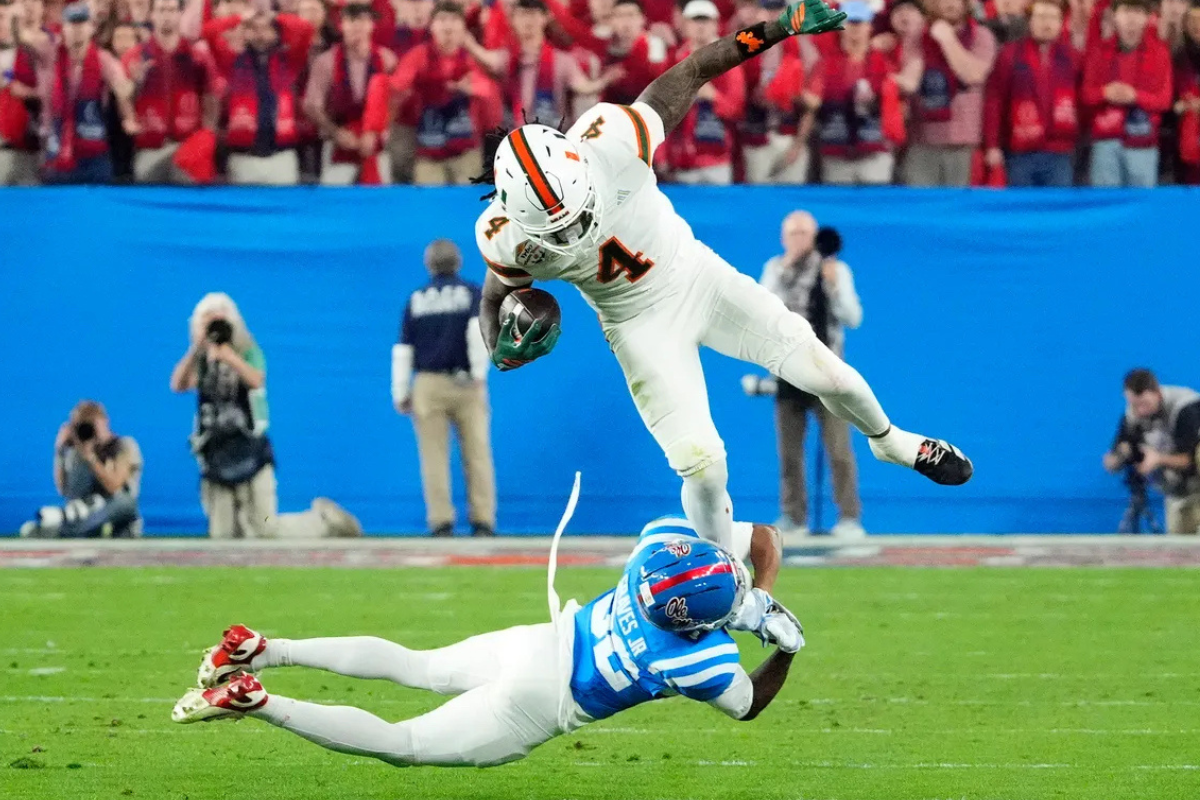
Photo by Rob Schmacher/The Republic
Ole Miss defender ,Chris Graves, Jr., attempts to tackle Miami Hurricanes running back, Mark Fletcher, Jr., in the Vrbo Fiesta Bowl in Glendale, AZ on January 8, 2025.
While the running game laid the foundation, quarterback Carson Beck delivered when it mattered most. Beck was steady rather than spectacular early, but as the stakes rose, so did his poise. In the second half, he began to find rhythm, making timely throws that kept Miami within striking distance and eventually pushed them ahead.
Midway through the third quarter, Beck engineered a pivotal drive that shifted momentum. On Miami’s fourth possession of the second half, he took a shotgun snap and quickly delivered a perfectly timed tunnel screen to Malachi Toney. With blockers set in front, Toney burst through the Ole Miss defense and raced 36 yards for a touchdown, giving Miami a 24–19 lead and igniting the Hurricanes’ sideline.
Ole Miss, however, refused to fold. Quarterback Trinidad Chambliss responded with confidence and urgency on the ensuing drive. Chambliss completed two of three passes for 44 yards and added a critical 19 yard scramble that flipped field position. The march was capped off with a 24-yard touchdown strike to Dae’Quan Wright. The Rebels then elected to go for two, and Chambliss delivered again, connecting with Caleb Odom to give Ole Miss a 27–24 advantage.
As the clock wound down, the game teetered on a knife’s edge. With just over three minutes remaining, Miami got the ball back needing either a game-tying field goal or a go-ahead touchdown. This was the moment Carson Beck had been waiting for.
Beck calmly dissected the Ole Miss defense on the final drive, mixing short completions with decisive runs to keep the chains moving. Facing pressure and knowing time was the enemy, he showed both composure and toughness. On the decisive play, with just 18 seconds left on the clock, Beck took the shotgun snap, rolled left, and powered his way into the end zone for a three-yard rushing touchdown. The score put Miami ahead for good and sent Hurricanes fans into a frenzy.
On that final drive, Beck finished 6-of-11 for 49 yards, adding the game-winning touchdown run that will live in Miami lore. The Hurricanes’ defense then rose to the occasion, holding firm in the closing seconds as Chambliss and Ole Miss made one last desperate push. When the final whistle blew, Miami had secured one of the most dramatic wins in recent college football memory.
Beyond the statistics and highlights, this game was a statement about Miami’s identity. The Hurricanes showed resilience when they fell behind, toughness in the trenches, and belief in critical moments. They didn’t rely on one player or one explosive play; instead, they trusted their system, their preparation, and each other.
Now, Miami turns its attention to the national championship stage. The Hurricanes will await the winner of the semifinal matchup between the Indiana Hoosiers and the Oregon Ducks to determine their opponent. Fittingly, the title game will be played on January 19, 2026, at Hard Rock Stadium, giving Miami a chance to compete for a championship on its home turf.
After years of waiting, rebuilding, and believing, the Hurricanes are back where they feel they belong, which is one win away from a national title.