
The SEC Has No Use for Almost
By the middle of October, you can usually tell.
Not by the record. Records lie in the SEC. You can tell by the body language. By how a team jogs out after halftime. By how quiet a stadium gets after a three and out that feels heavier than the score says it should.
That’s when a season shifts from building to surviving.
This is the part of SEC football no one markets. The part where teams aren’t bad enough to tear it all down, not good enough to protect themselves, and slowly get worn down by a league that no longer leaves room for being solid.
That middle space , the SEC’s middle class, is disappearing in real time.
When “Pretty Good” Stopped Being Safe
There was a time when an 8–4 season meant momentum. A bowl win meant continuity. Returning starters meant the foundation was set.
That logic doesn’t hold anymore.
Outside the top tier, the SEC has started to feel like a closed loop. A few programs insulated at the top, a few clearly rebuilding at the bottom, and everyone else living in a narrow band where one bad month can change everything. Seasons don’t stack. They reset. The league hasn’t become more balanced. It’s become more polarized.
And the teams caught in between aren’t failing, they’re just standing still. In the modern SEC, that’s almost the same thing.
Arkansas and Florida: Two Ways the Floor Drops
Arkansas and Florida took different roads to the same destination in 2025. Together, they’re the starkest evidence of what middle class exposure eventually costs you.
Let’s start with Arkansas. When Sam Pittman was hired in December 2019, he was a career offensive line coach nobody outside of Georgia’s fan base had heard of. He inherited a program that had gone 4–20 in two years under Chad Morris and hadn’t won an SEC game in 20 consecutive tries. Within two years, he’d turned it around to nine wins in 2021, a ranked finish, and an Outback Bowl victory over Penn State. This was the first time Arkansas had cracked the top 25 since 2011. He’d done everything right.
Then the floor shifted under him. The 2022 season, he was 7–6 as a head coach. The 2023 season was an abysmal 4–8 record. He survived it and hired Bobby Petrino as offensive coordinator and turned out a 7–6 record in 2024. Three bowl wins and 32 victories overall —equals the best winning percentage at Arkansas since Petrino’s own tenure from 2008 to 2011. He came into 2025 on the hottest of hot seats. He tried to address speculation at SEC Media Days and said the team would be special if they could just take care of the ball. Notre Dame came to Fayetteville on September 27th and won 56–13. The next morning, Pittman was fired. His buyout: $9.3 million. His final conference record: 14–29.
The detail that cuts the deepest isn’t the blowout, it’s that Arkansas turned to Bobby Petrino, the same man who’d been fired from this same job in 2012 after a motorcycle crash revealed a secret relationship with a football staffer he’d secretly hired and paid $20,000, as their interim answer. The program had come so far, and the middle class had squeezed it back to the beginning.
Florida’s version of the same story took four years to arrive but landed just as hard. Billy Napier went 22–23 across his tenure, the worst winning percentage for a Florida coach since the 1940s. The 2025 season was supposed to be the reset with a preseason top15 ranking, 18 returning starters, and a freshman quarterback who’d shown real promise. The Gators lost at home to South Florida in Week 2. This was the first loss in program history to the Bulls and the season never recovered. Napier was fired seven games in, at 3–4.
What makes Florida’s collapse instructive isn’t just the losing, it’s the pattern. Napier went 8–5 in 2024 and received a public vote of confidence. The next year, the same structural problems resurfaced within weeks: offensive stagnation, an inability to win big road games, and clock management issues that had become a running joke. One promising season didn’t fix anything. It bought time.
In the modern SEC, the middle class doesn’t get to bank progress. It gets to start over.
Kentucky: When a Model Stops Working
The Kentucky case is the most methodical and, for that reason, of any program in this piece.
Mark Stoops arrived in 2013 inheriting a two win program that had gone 2–10 under Joker Phillips. Over 13 seasons, he rebuilt it from the ground up. He became Kentucky’s all-time winningest coach, surpassing Bear Bryant. He delivered the program’s first 10-win season since 1977. He built eight consecutive bowl appearances, the longest streak in school history. He was, by any measure, a program builder. When Nick Saban retired after the 2023 season, Stoops became the longest-tenured coach in the SEC, a distinction that had once meant something.
The NIL era changed the calculus. Stoops turned to the transfer portal heavily in 2025, bringing in 27 new players to stabilize a roster that had gone 4–8 the year before. It didn’t work. Kentucky started 3–5, lost its first five SEC games, and ended the season getting shutout 41–0, by in-state rival Louisville. Stoops stood at the postgame podium and said there was “zero percent chance” he would walk away from the job. The decision, he noted, wasn’t his.
On December 1, he was fired with an $38 million buyout. He left as the sixth SEC program to change coaches that season, joining Auburn, Arkansas, Florida, LSU, and Ole Miss. His final record being 82–80, though 10 wins were later vacated by the NCAA.
Read that number again: 82–80 and fired. The winningest coach in program history, gone. Not because the model was wrong, but because the model stopped producing fast enough. Patience, in the modern SEC, is a resource that runs out whether you’ve earned it or not.
South Carolina: The Danger in Breakthrough Seasons
South Carolina might be the most instructive case in this piece. It”s not because they struggled, but because they succeeded.
Shane Beamer won the 2024 SEC Coach of the Year award. His Gamecocks went 9–4, finished 5–3 in the SEC, and put together a six-game winning streak that included three consecutive wins over ranked opponents, the first time a South Carolina coach had ever done that. They beat No. 10 Texas A&M by 24 points at home. They entered 2025 ranked No. 10 in the AP poll, their highest preseason ranking since 2014. LaNorris Sellers, his sophomore quarterback, was a legitimate Heisman contender. The program hadn’t felt this way since Steve Spurrier.
Then the 2025 season happened. South Carolina started 2–0, rose to No. 10, then lost seven of their next eight games. By mid-November they were 3–7. They finished 4–8 overall, 1–7 in the SEC.
The details make it worse. They beat Virginia Tech in the opener and rose into the top 10 for the first time in over a decade. Then came Missouri, Kentucky, and LSU. Seven of the next eight opponents beat them. The same team that had made history winning three consecutive games against ranked opponents in 2024 couldn’t string together two wins in a row, in conference play in 2025.
That swing from SEC Coach of the Year to 1–7 in conference play, in 12 months, is what separates this league from any other. Beamer didn’t lose his talent. He lost his margin. A breakthrough season in the SEC isn’t a platform. It’s a high water mark and when the depth thins and the hits pile up, the tide goes out just as fast. Momentum, in this league, isn’t stored. It expires.
AP Photo/Gerald Herbert
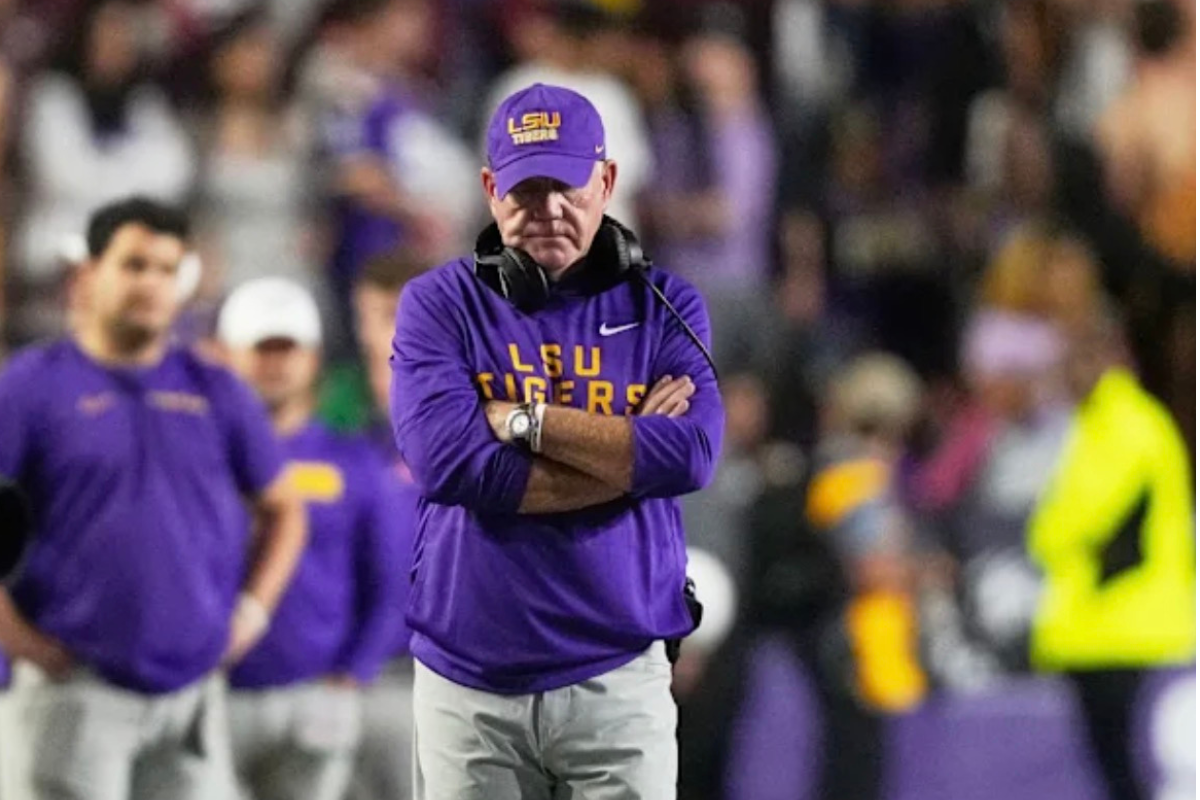
Brian Kelly walks the sideline during a loss in the final of head coaching tenure at LSU on Saturday, October 25, 2025.
LSU: The Clearest Proof That Good Isn’t Good Enough
If Arkansas and Florida show what the bottom of the middle looks like, LSU shows what happens near the top of it. This is the most alarming data point in this entire argument.
Brian Kelly arrived at LSU in 2021 with a resume that was almost impossible to argue with. He’d won over 60% of his games everywhere he’d coached. He went 34–14 in four seasons at LSU, posting back-to-back 10-win seasons. He opened the 2025 season by beating Clemson on the road and climbing to No. 3 in the country. His career winning percentage ranked third among active Power Four coaches. On paper, he was building something.
He was fired on October 26 with a $54 million buyout, the second largest mid-season firing in college football history, after going 5–3.
Not 3–5. Five and three.
Athletic director Scott Woodward didn’t hide the reasoning. He said the success that LSU demands “simply did not materialize.” Three straight losses to ranked opponents had ended any realistic CFP hope. Kelly had never made the Playoff. He’d never won a conference title. He’d won a lot of games, but it wasn’t enough. Winning games and contending for a national championship are now two different things in this league, and only one of them secures a coach’s future.
That’s not a firing. That’s a verdict. And it tells you everything about what the SEC now demands from the programs living between elite and rebuilding. Not just winning but ascending. Not just competing but contending. The gap between those two things has never been more expensive to ignore.
The Portal and NIL Didn’t Break the Middle — They Compressed It
The transfer portal and NIL didn’t ruin the SEC. They clarified it.
Elite programs reload faster now. Struggling programs sell patience and patience alone. Middle tier programs relied on continuity, steady recruiting classes, developing players over three or four years and building culture slowly. That model is now optional. Offseason roster turnover isn’t occasional for most teams. It’s annual. And when large portions of your team changes every year, Saturdays start feeling like introductions instead of progress.
Develop a player well, and someone else benefits. Miss on a position group for one cycle, and the schedule punishes you immediately. There’s no buffer. No slow build. No grace period.
Kentucky brought in 27 portal players in 2025 and still couldn’t survive. Arkansas tried to reload with 31 transfers and got blown out by Notre Dame. The portal didn’t save them. It just changed what losing looks like.
The middle class didn’t die because it ran out of talent. It died because it ran out of time to develop it.
Coaches Aren’t Building — They’re Managing Exposure
Listen to SEC coaches now and you’ll hear the shift. Less talk about “year three.” More talk about urgency. About answers. About right now.
Tenures are shorter. Patience is conditional. Six SEC programs fired or lost coaches in 2025 alone. Those programs are Auburn, Arkansas, Florida, LSU, Ole Miss, and Kentucky. This a number that would have been unthinkable a decade ago for a single conference in a single season. Coaches aren’t architects anymore. They’re managers by renting rosters, plugging leaks, trying to buy time. That’s not incompetence. That’s adaptation to an environment that no longer rewards vision. It rewards results, and it rewards them quickly.
The coach who manages exposure best isn’t the one who builds the best program. He’s the one who survives long enough to get a second contract.
Auburn: The Question the Middle Class Can’t Escape
Auburn doesn’t sit in the middle because it lacks ambition. It sits there because even programs with history, resources, and genuine recruiting power aren’t immune to the squeeze anymore.
Hugh Freeze arrived in 2023 with momentum. He signed two consecutive top 10 recruiting classes. He brought in Cam Coleman, one of the most physically gifted receivers in the country. He swung for a star quarterback when he landed Jackson Arnold, a former five-star from Oklahoma. On paper, the 2025 season was supposed to be the payoff. Year three, the roster coming together, the offense finally becoming what Freeze had promised.
Auburn opened 3–0, beat Baylor on the road, climbed to No. 22. Then they hit SEC play and went scoreless. Arnold went three straight conference games without a passing touchdown. Freeze benched him for Stanford transfer Ashton Daniels. Then they lost to Kentucky at home and the Auburn student section began chanting for Freeze to be fired before the final whistle had blown. He was fired the next morning, November 2, with a $15.4 million buyout. His three-year record was 15–19. The worst three-year start by an Auburn head coach in 70 years.
Cam Coleman transferred to Texas. He’d led Auburn with 708 receiving yards and five touchdowns in 2025. The best receiver on a team that desperately needed him and he was gone inside of six weeks after the season ended. His NIL valuation climbed from $1.8 million to $2.5 million the moment he committed to the Longhorns. Auburn had developed him. Texas benefited.
Alex Golesh was hired November 30. He’s a bet on modern offense, modern roster management, and the idea that Auburn can climb out of the squeeze instead of just managing it. But the challenge isn’t scheme. It’s environment. Can Auburn give a coach what the SEC middle class no longer guarantees, which is time, continuity, and patience. When the last coach who signed top 10 recruiting classes back to back was still fired before Thanksgiving?
The Real Shift No One Likes Talking About
The SEC still sells depth. Still sells chaos. Still sells the idea that anybody can beat anybody on any given Saturday.
But the truth is simpler. The league rewards extremes. The elite get margin for error. The struggling get time to rebuild. The middle gets squeezed from both ends and told to compete anyway.
Arkansas survived the SEC’s middle class for five years and got blown out by Notre Dame on a Saturday morning, with no second act waiting. Florida spent four years trying to find its footing, but Napier left with the worst winning percentage the program had seen in eighty years. Kentucky built a decade of proof, Stoops became the winningest coach in school history, and still couldn’t outrun two losing seasons in a row. South Carolina’s Shane Beamer won SEC Coach of the Year and was 1–7 in conference play twelve months later. LSU fired a coach at 5–3 with a $54 million check and called it a necessary decision. Auburn reflected it all most clearly because Auburn has the history, the recruiting footprint, and the resources to understand exactly how much harder this has gotten, and none of it was enough to protect them either.
Six SEC programs hired new coaches in a single offseason. Six. In one conference. In one year.
In the modern SEC, being good isn’t a foundation. It’s a risk. And until the league finds room for stability again, the middle class will keep shrinking not because these programs are failing, but because standing still has become the most dangerous place of all.